Skills
 React Native
  Expo
Expo  TypeScript
  TanStack Query React
 Other services
What is mobile development?
Mobile development involves creating native or hybrid applications for iOS and Android platforms. It leverages device-specific features such as geolocation, camera, push notifications, and sensors.
A mobile application can be developed in several ways: natively (Swift for iOS, Kotlin for Android), which offers the best performance but requires two separate developments, or cross-platform ( React Native, Flutter), allowing most of the code to be shared between both platforms while maintaining a native user experience.
Mobile development goes beyond simply creating an interface. It also includes application state management , data synchronization with a server, performance optimization to save battery life, offline mode management, and accommodating different screen sizes and operating system versions.
Our mobile development team pays special attention to the mobile user experience , which differs from the web. Touch interactions, gesture navigation, and mobile accessibility are at the heart of our concerns to deliver an intuitive and performant application.
We're available
Let's discuss your mobile project and find the best approach to develop your application together.


Custom mobile application development
Whether you need a mobile application for your customers, your employees, or your sales force, we have the technical expertise to create performant mobile applications tailored to your business needs.
We primarily use React Native and Expo to develop cross-platform applications, allowing us to share code between iOS and Android while maintaining native performance. Our mastery of TypeScript, TanStack Query, and the React ecosystem enables us to build robust and maintainable applications.
We also integrate advanced features such as biometric authentication, push notifications, geolocation, in-app payments, and real-time synchronization.
Our mobile development experts






Start UI [native]
Our open source mobile starter built on React Native and Expo provides authentication, dark mode, and store deployment tools. Aligned with our web starter and Figma kit, it enables our developers to create native mobile applications sharing the same logic and visual consistency.
Get on GitHub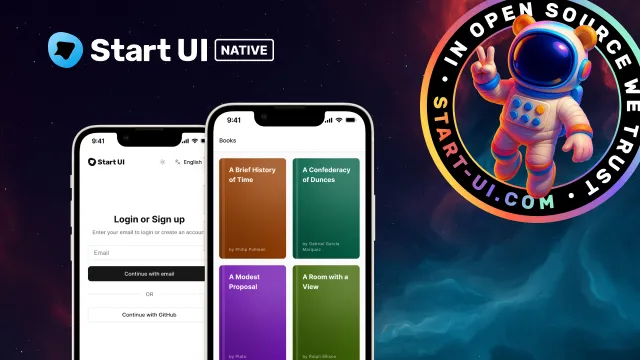
What are the most used technologies at BearStudio?
For mobile application development, we primarily use React Native , a framework created by Meta that enables developing native iOS and Android applications with JavaScript. We pair it with Expo , a suite of tools that significantly simplifies development, testing, and deployment of React Native applications.
These technologies allow us to share up to 95% of the code between iOS and Android while delivering a native experience to users. We also benefit from the React ecosystem that we already master for web development , ensuring consistency in our practices and code quality.
Frequently asked questions about mobile development
Find answers to the most common questions about mobile application development, our methodologies, and best practices.
What is the difference between a native and a hybrid application?
A native application is developed specifically for a platform (iOS or Android) using official languages and tools (Swift/SwiftUI for iOS, Kotlin for Android). It offers the best performance and full access to platform features, but requires developing and maintaining two separate applications.
A hybrid or cross-platform application is developed with a single codebase that works on multiple platforms. With technologies like React Native or Flutter, you get near-native performance while sharing most of the development effort. It's generally the best compromise between quality, cost, and development speed.
Why choose React Native over native development?
React Native allows developing for both iOS and Android with a single codebase, which significantly reduces costs and development timelines. Updates and fixes are faster since there's only one codebase to maintain.
React Native performance is excellent for the vast majority of use cases. The user interface is compiled into native components, providing a smooth and responsive experience. Additionally, if needed, it's possible to write native modules in Swift or Kotlin for specific features requiring maximum performance.
The React Native ecosystem is mature and very active, with a large community and numerous available libraries. It's maintained by Meta and used by leading applications such as Facebook, Instagram, Discord, Shopify, and Microsoft Office.
What is Expo and why use it?
Expo is a platform that significantly simplifies development with React Native. It provides a set of tools and services that accelerate development, testing, and deployment.
Expo offers a comprehensive SDK with access to all native features (camera, geolocation, notifications, etc.) without needing to configure native code. The cloud build system (EAS Build) allows compiling applications without needing a Mac for iOS.
Expo's OTA updates (Over-The-Air) system allows deploying fixes and new features instantly without going through the stores, as long as the changes don't involve native code.
How to optimize mobile application performance?
Thanks to our component library Ficus UI, we optimize your application's rendering while preserving your brand's design.
We also optimize image loading and caching, which are often the main source of slowdowns. Animations are built with Reanimated, which runs animation code on the native UI thread for optimal performance.
The JavaScript bundle size is minimized through code-splitting and tree-shaking. We also monitor memory consumption and use profiling tools to identify and fix bottlenecks.
Why choose BearStudio for your mobile development?
Mobile development is one of BearStudio's key areas of expertise. We have developed numerous mobile applications for startups and large companies, with varied challenges ranging from simple showcase apps to complex business applications.
Our mastery of React Native and Expo allows us to quickly deliver professional-quality applications while maintaining the flexibility needed to adapt to your specific requirements.
We are highly attentive to UI and UX concerns and know how to adapt interfaces to mobile specifics: touch interactions, gesture navigation, and adaptation to different screen sizes.
We consider accessibility from the design phase to ensure your applications are usable by everyone, including people with disabilities.
Our collaborative approach and transparent communication throughout the project ensure that your mobile application perfectly meets your expectations and your users' needs.
Can you easily publish to the iOS and Android stores?
Yes, we support our clients through the entire publishing process on the App Store (iOS) and Google Play Store (Android). This includes creating developer accounts, preparing assets (icons, screenshots, descriptions), and submitting applications.
We also handle reviews and any modification requests from the stores. With Expo's EAS Submit, the submission process is greatly simplified and can even be automated in a CI/CD pipeline.
For minor updates that don't require native changes, we use OTA updates that allow instant deployment without going through store validation.